Dental Article
Can You Get Dental Implants After Years of Wearing Dentures?
If you’ve been wearing dentures for a long time, you’ve likely noticed changes in how they fit. Maybe they’ve become loose, or you’re using more adhesive than you used to. It’s natural to wonder: "After all these years, do I still have enough jawbone left for dental implants?"
Schedule Free Consultation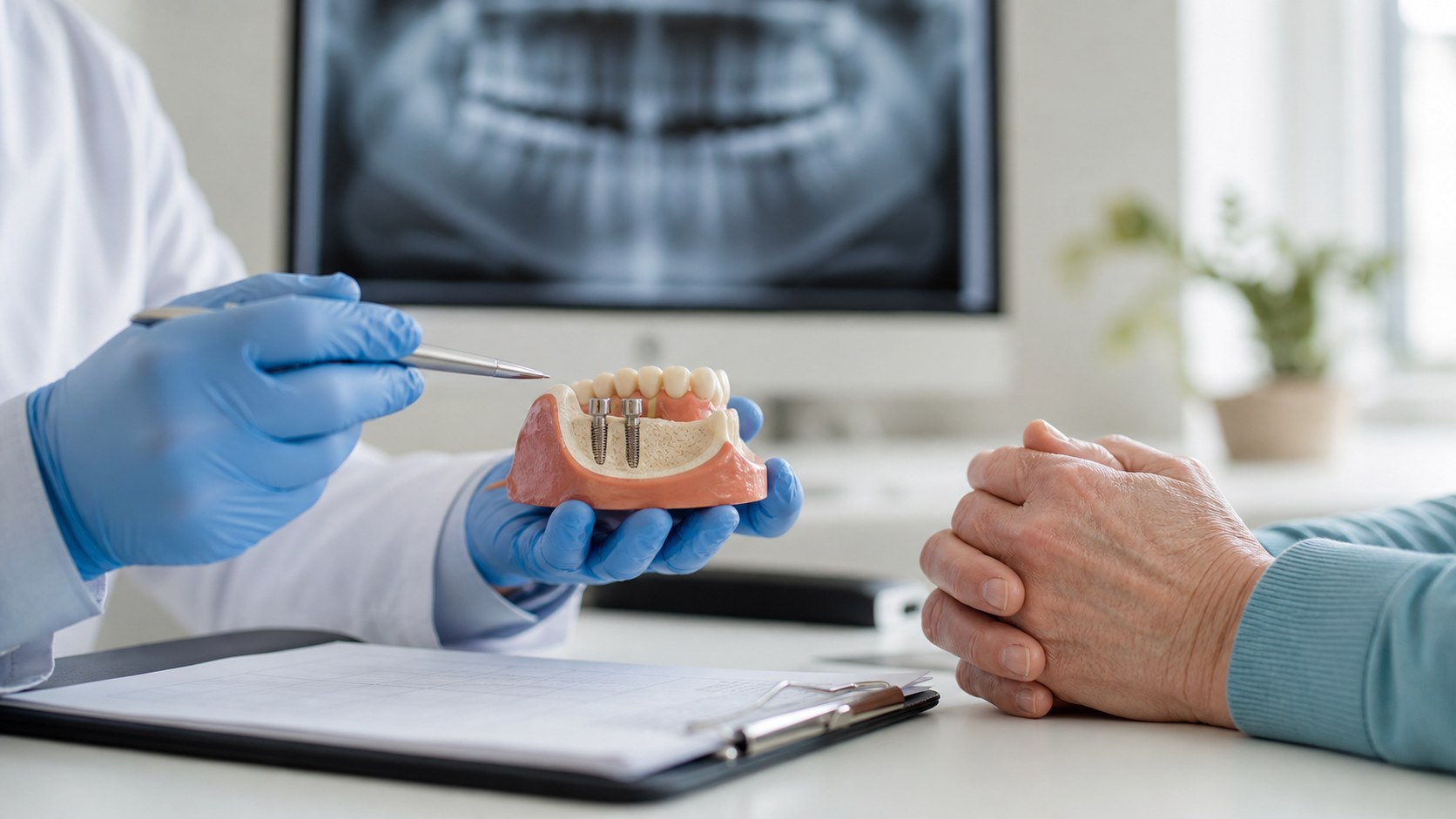

The short answer is: Even with significant bone loss, there is almost always a solution that can get you back to a permanent, confident smile.
Understanding Bone Loss and Dentures
When you lose natural teeth, the jawbone no longer receives the stimulation it gets from chewing. Like a muscle that withers without exercise, the bone begins to resorb (shrink). Total tooth loss (edentulism) is considered a physical disability by the World Health Organization, and long-term denture use can actually accelerate bone resorption, particularly in the lower jaw (Jawad et al., 2017).
If you’ve been a denture wearer for a decade or more, your bone levels are likely lower than they were on day one. However, "low bone density" is no longer the "no" it used to be.
How Dentists & Surgeons Evaluate "Enough Bone"
To determine if you are a candidate for implants, a restorative dentist or oral surgeon will use a CBCT scan (3D X-ray). They aren't just looking at the height of the bone, but also the:
Width: Is the bone thick enough to screw in a post?
Density: Is the bone quality strong enough to support biting forces?
Proximity to Vital Structures: Where are your nerves and sinus cavities located?
Solutions for Long-Term Denture Wearers
If a scan shows you’ve lost significant bone, modern technology offers several "workarounds" that eliminate the need for a perfect, original jawbone.
1. Bone Grafting
This is the most common solution. A dentist can "build back" the bone using specialized grafting material. Studies show that dental implants placed in grafted bone have an average survival rate of approximately 98.5% (Elakkiya et al., 2017). Once the graft heals and integrates with your natural bone (usually a few months), it creates a solid foundation for a standard implant.
2. All-on-4® (Teeth in a Day)
This technique is a game-changer for long-term denture wearers. Instead of needing an implant for every tooth, surgeons place four to six implants at specific angles. By tilting the implants, they can utilize the denser bone available in the front of the jaw, often avoiding the need for bone grafts entirely while maintaining high success rates comparable to axial implants (Sylvester, 2019).
3. Zygomatic Implants
For patients with extreme bone loss in the upper jaw, Zygomatic implants are an option. These are longer implants that anchor into the cheekbones (zygoma) rather than the jawbone. Recent 10-year follow-up studies have shown that zygomatic implants maintain excellent stability and high success rates (99.0%) even in cases of severe atrophy (Duarte et al., 2025).
4. Sinus Lifts
If you lack bone in the upper back of your mouth, a sinus lift can create space. Research indicates that the use of specialized membranes during these procedures is a significant factor in achieving long-term implant survival in the grafted maxillary sinus (Duttenhoefer et al., 2013).
Why Take the Leap Now?
The best time to look into implants is today. Bone resorption doesn't stop; it continues as long as the roots are missing. Moving from dentures to implants doesn't just improve your ability to eat and speak—it stabilizes the remaining bone and prevents the "sunken" facial appearance often associated with long-term denture use.
The Verdict: Don't self-diagnose based on how long you’ve had dentures. With modern advancements like 3D imaging and angled implants, nearly everyone is a candidate for some form of implant-supported restoration.